1935F Silver Certificate Value & 1935 $1 Price Chart
Quick answer
1935 F silver certificate value: $1.50 circulated and $10+ uncirculated (USCA, Sept 25, 2026); stars $6–$285 (Greysheet). Every 1935 $1 series priced.
Updated 2026-09-25 · Sources: greysheet.com, Wikipedia, uscurrencyauctions.com, littletoncoin.com
Have one? Scan it to see what it's worth.
Download on the App StoreWhat are the key facts?
- Denomination: $1
- Series covered: 1935, 1935A, 1935A Hawaii, 1935A North Africa, 1935B, 1935C, 1935D Wide Border, 1935D Narrow Border, 1935E, 1935F, 1935G Motto, 1935G No Motto, 1935H
- Type: Silver Certificate
- Seal colour: blue / brown / yellow
- Signature pairs: 13 (one per series letter, listed below)
- Star notes: Yes
- Printed: From 1935
- Value range (Greysheet): $1.50–$25,000
What this series looks like
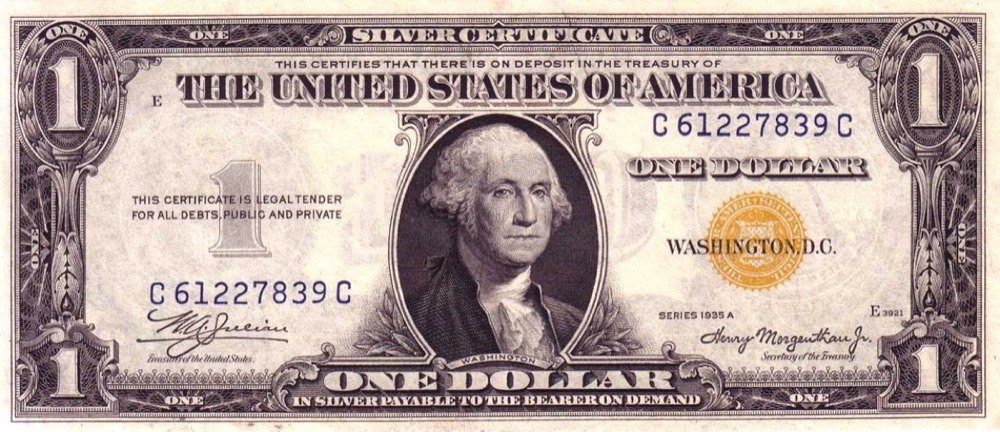
Series 1935. Front: the blue numeral 1 on the left was changed to a smaller gray one; the gray ONE on the right was removed; the Treasury seal was made smaller, with WASHINGTON D.C. printed above it; a scripted ONE DOLLAR was added above the seal. The back changed to the design still in use today (the pyramid/eagle great seal, not the Funnyback), though IN GOD WE TRUST was not yet present at this point.
Series 1935A Hawaii. Issued specially in 1942 so that notes could be declared void if Hawaii were invaded and the notes captured by Japanese forces: both the front and back are overprinted with the word HAWAII, and the seal and serial numbers are changed to brown (the Silver Certificate article's wording describes this group as a Silver Certificate; the comparison text in the Wikipedia article mainly describes the overprint details for the $5/$10 Federal Reserve Note versions, while the $1 table itself only marks the seal color for this row as Brown).
Series 1935A North Africa. Printed for distribution to Allied forces stationed in North Africa, so the notes could be declared void if captured by the enemy; the main identifying feature is the yellow Treasury seal (the rest of the design is the same as the 1935 series).
Series 1935D Wide Border. 1935D exists in two border-width varieties, wide and narrow (the page cites an external PDF specifically discussing this difference, but that PDF was not opened this time; only the presence of these two rows in the Wikipedia table was confirmed).
Series 1935G Motto. Among 1935G notes with the same signatures, some printed on the old 18-subject presses began carrying IN GOD WE TRUST (because the old plates continued to be used into the 1960s).
Series 1935G No Motto. After Congress legislated in 1957 that IN GOD WE TRUST be added to all currency, the BEP first added the motto using new 32-subject presses; but some 1935G notes printed on 18-subject presses still used the old no-motto layout, so 1935G exists in both No Motto and Motto versions.
Series 1935H. 1935H was printed only with the IN GOD WE TRUST layout (no no-motto version exists).
Signatures by series letter
- Series 1935 — Julian (Treasurer) and Morgenthau (Secretary), blue seal
- Series 1935A — Julian (Treasurer) and Morgenthau (Secretary), blue seal
- Series 1935A Hawaii — Julian (Treasurer) and Morgenthau (Secretary), brown seal
- Series 1935A North Africa — Julian (Treasurer) and Morgenthau (Secretary), yellow seal
- Series 1935B — Julian (Treasurer) and Vinson (Secretary), blue seal
- Series 1935C — Julian (Treasurer) and Snyder (Secretary), blue seal
- Series 1935D Wide Border — Clark (Treasurer) and Snyder (Secretary), blue seal
- Series 1935D Narrow Border — Clark (Treasurer) and Snyder (Secretary), blue seal
- Series 1935E — Priest (Treasurer) and Humphrey (Secretary), blue seal
- Series 1935F — Priest (Treasurer) and Anderson (Secretary), blue seal
- Series 1935G Motto — Smith (Treasurer) and Dillon (Secretary), blue seal
- Series 1935G No Motto — Smith (Treasurer) and Dillon (Secretary), blue seal
- Series 1935H — Granahan (Treasurer) and Dillon (Secretary), blue seal
The wording on the face
This certifies that there is on deposit in the Treasury of the United States of America X dollars in silver payable to the bearer on demand
How to confirm the series
- The back already uses the current design (great seal/pyramid and eagle), no longer the Funnyback
- IN GOD WE TRUST does not appear above the ONE on the back
- The front seal is smaller and has WASHINGTON D.C. printed above it
- The numeral 1 on the left is gray and smaller
- The seal and serial numbers are brown rather than the standard blue
- The word HAWAII is overprinted on both front and back
- The rest of the design is the same as the 1935 series
- The Treasury seal is yellow (as opposed to the standard blue)
- The serial number color was not separately noted in the pages read
- Overall design same as the 1935 series
- The border is wider than the narrow-border version (the exact width difference was not verified and requires the original PDF source)
- The border is narrower than the wide-border version
- IN GOD WE TRUST appears above the ONE on the back
- IN GOD WE TRUST always appears above the ONE on the back
Easily confused with
The only difference from the 1957 series is whether IN GOD WE TRUST appears above the ONE on the back: the 1935 series (including A–F and G No Motto) does not have it, while 1957 onward always does; 1935G Motto and 1935H also already carry it.
Difference from the 1935A North Africa version: the Hawaii version has a brown seal and the HAWAII overprint text; the North Africa version has a yellow seal, and no overprint text was found for the North Africa version.
Difference from the 1935A Hawaii version: the North Africa version has a yellow seal and no HAWAII overprint; the Hawaii version has a brown seal and the HAWAII overprint.
The 1935D wide-border and narrow-border versions differ only in border width; the signatures are the same (both Clark / Snyder), so the border width must be measured to distinguish them.
See the entry above for distinguishing this from the 1935D wide-border version.
See the entry above for the difference from the 1935G No Motto version with the same signatures; the difference from 1935H (which also carries the motto) is the signatures (Smith / Dillon vs. Granahan / Dillon).
The only difference from the 1935G Motto version with the same signatures is whether IN GOD WE TRUST appears on the back; having or lacking the motto has no bearing on the note's value (the source explicitly states there is no particular difference in value if a bill does or does not have the motto).
Differs from the 1935G Motto version by signatures; differs from 1957B (also Granahan / Dillon) only in that "1935H" and "1957" are different series-year labels — the two are otherwise identical in appearance and specifications, with only the series-year text differing.
How much is a $1 Silver Certificate Series 1935 worth?
Greysheet (Greensheet & Friedberg CPG) retail value ranges, updated September 25, 2026, from a worn circulated note to a top-grade crisp uncirculated one:
- 1935 (Fr. 1607): $3–$500
- **1935 Star Replacement (Fr. 1607*):** $35–$950
- **1935 Mule, Star Replacement (Fr. 1607m*):** $4,375–$4,375
- 1935A (Fr. 1608): $2–$300
- **1935A Star Replacement (Fr. 1608*):** $3–$500
- 1935A R Experimental (Fr. 1609): $80–$2,400
- **1935A R Experimental, Star Replacement (Fr. 1609*):** $1,400–$25,000
- 1935A S Experimental (Fr. 1610): $80–$2,300
- **1935A S Experimental, Star Replacement (Fr. 1610*):** $1,050–$20,000
- 1935B (Fr. 1611): $2–$200
- **1935B Star Replacement (Fr. 1611*):** $16–$420
- 1935C (Fr. 1612): $1.50–$140
- **1935C Star Replacement (Fr. 1612*):** $3–$250
- 1935D (Fr. 1613N): $1.50–$150
- **1935D Star Replacement (Fr. 1613N*):** $3–$750
- **1935D Star Replacement (Fr. 1613W*):** $3–$550
- 1935D (Fr. 1613W): $1.50–$240
- 1935E (Fr. 1614): $1.50–$140
- **1935E Star Replacement (Fr. 1614*):** $5–$140
- 1935F (Fr. 1615): $1.50–$260
- **1935F Star Replacement (Fr. 1615*):** $6–$285
- 1935G (Fr. 1616): $2–$120
- **1935G Star Replacement (Fr. 1616*):** $2.50–$185
- 1935G (Fr. 1617): $4–$185
- **1935G Star Replacement (Fr. 1617*):** $9–$400
- 1935H (Fr. 1618): $2–$85
The low end is a folded, circulated note; the high end is a gem uncirculated note, usually one certified by PMG or PCGS Banknote. Star notes (a star next to the serial number) replaced misprinted sheets and usually sell above the regular note. Condition moves the price more than anything else: a note that has been folded even once is no longer uncirculated. Fancy serial numbers can add more; check yours with the serial number checker.
1935F silver certificate: value and identification
A 1935F $1 silver certificate is worth about $1.50 in circulated condition and $10+ uncirculated (US Currency Auctions, viewed September 25, 2026). Greysheet (September 25, 2026) ranges the regular 1935F (Fr. 1615) from $1.50 to $260 and the 1935F star (Fr. 1615*) from $6 to $285, the top ends being for top-grade certified notes. Dealers were retailing crisp uncirculated 1935F notes at $56.95 (Littleton Coin Company) and $17.50 (Golden Eagle Coin) on the same day. To confirm you have a 1935F:
- The signatures are Priest (Treasurer) and Robert B. Anderson (Secretary). Anderson served as Secretary of the Treasury from July 29, 1957 to January 20, 1961 (Wikipedia), which dates the printing.
- The back has the pyramid and eagle but no IN GOD WE TRUST.
- The seal and serial numbers are blue.
The Series 1957 $1 has the same Priest and Anderson signatures; the difference is the motto on the back, which 1957 has and 1935F does not.
Which 1935 silver certificate is worth the most
In the Greysheet chart above (September 25, 2026), the 1935A experimental notes lead: the R star ranges $1,400–$25,000 and the S star $1,050–$20,000, and even the regular R and S notes range $80–$2,400. A red R or S is printed on the front of these notes. Next is the 1935 mule star at $4,375. The HAWAII brown-seal and North Africa yellow-seal 1935A notes list $30–$60 and $40–$80 circulated (US Currency Auctions, viewed September 25, 2026). Plain 1935B to 1935H notes list $1.50–$7 circulated.
Errors on 1935 silver certificates
The one error-type listing in the Greysheet chart is the 1935 "mule" star (Fr. 1607m*) at $4,375. In numismatics a mule is an item made with two sides that were not normally paired (Wikipedia), and Greysheet prices this 1935 variety separately. Other errors on silver certificates, such as shifted or missing printing and cutting errors, are valued one by one, so a note that looks wrong should be checked by a currency dealer or grader rather than priced from a chart. Folds, stains and tears that happened after the note left the printer are damage, not errors.
Should you keep or sell a 1935 silver certificate?
For a circulated 1935B to 1935H note, the numbers are small either way: a dealer buying it will pay less than the $1.50–$7 guide price, and it remains legal tender at $1 (Wikipedia). Keep it if you like it. Sell, or have it graded first, if it is uncirculated, a star, a 1935A R or S, a HAWAII or North Africa note, or has a fancy serial number; check the serial with the serial number checker.
FAQ
How do I know which Series 1935 letter my bill is?
The series year and letter are printed on the face near the portrait. If the letter is worn, match the two signatures against the list above; each letter has its own pair.
Is a $1 Silver Certificate Series 1935 still legal tender?
Yes at face value, but it can no longer be exchanged for silver; that redemption ended in 1968.
Does a star make my $1 Series 1935 note rare?
Only if its print run was small. The star alone does not.
How much is a 1935F $1 silver certificate worth?
About $1.50 circulated and $10+ uncirculated (US Currency Auctions, viewed September 25, 2026); Greysheet ranges it $1.50–$260 and its star $6–$285 up to top grade.
What is the error on a 1935 silver certificate?
The error-type variety priced by Greysheet is the 1935 mule star at $4,375. Other printing errors are valued individually.
Which 1935 silver certificate is worth the most?
The 1935A experimental R and S star notes, ranging up to $25,000 and $20,000 in top grade (Greysheet, September 25, 2026).
How can I find the serial number of a 1935 F silver certificate?
It is printed in blue on the front: a letter, eight digits and a letter. A star at one end marks a replacement note.
Should I keep or sell my 1935 silver certificate?
A worn common letter is worth a few dollars at most, so keeping it costs little. Sell or grade stars, R and S notes, wartime issues and uncirculated notes.
How do I know if my silver certificate is worth money?
Check the series letter, look for a star, a red R or S, a brown or yellow seal, or a fancy serial, and judge whether it has ever been folded.
More in Silver Certificate Value by Series: $1, $5 and $10 Price Chart
Related
See what your notes are really worth.
Start with a single scan.
Have one? Scan it to see what it's worth.
Sources
- greysheet.comwww.greysheet.com/prices/sp/
- Wikipediaen.wikipedia.org/wiki/United_States_one-dollar_bill
- uscurrencyauctions.comwww.uscurrencyauctions.com/$1-us-currency-value-price-guide.html
- littletoncoin.comwww.littletoncoin.com/shop/1935f-$1-silver-certificate-fr1615-wc
- goldeneaglecoin.comwww.goldeneaglecoin.com/item/1935f-1-silver-certificate-unc
- Wikipediaen.wikipedia.org/wiki/Robert_B._Anderson
- Wikipediaen.wikipedia.org/wiki/Mule_(coin)
Compiled by the NoteLens editorial team
Every fact on this page is taken from the sources listed above; numbers and prices are copied from the source, and prices name the guide or auction and its date. Research and drafting were assisted by AI, and each claim was then checked against the cited sources. Checked 2026-09-25. We do not buy, sell or grade items; the app identifies what you photograph and points you to these references.