1928 Silver Certificate Value: $1 Funnyback Price Chart
Quick answer
1928 silver certificate value: most $1 notes list $8–$22 worn, but 1928E lists $300–$700 and a 1928D star up to $100,000 (USCA, Greysheet, Sept 2026).
Updated 2026-09-25 · Sources: greysheet.com, Wikipedia, uscurrencyauctions.com
Have one? Scan it to see what it's worth.
Download on the App StoreWhat are the key facts?
- Denomination: $1
- Series covered: 1928, 1928A, 1928B, 1928C, 1928D, 1928E
- Type: Silver Certificate
- Seal colour: blue
- Signature pairs: 6 (one per series letter, listed below)
- Star notes: Yes
- Printed: 1928–1934 (this design remained in use until replaced by the 1934 series)
- Value range (Greysheet): $20–$100,000
What this series looks like
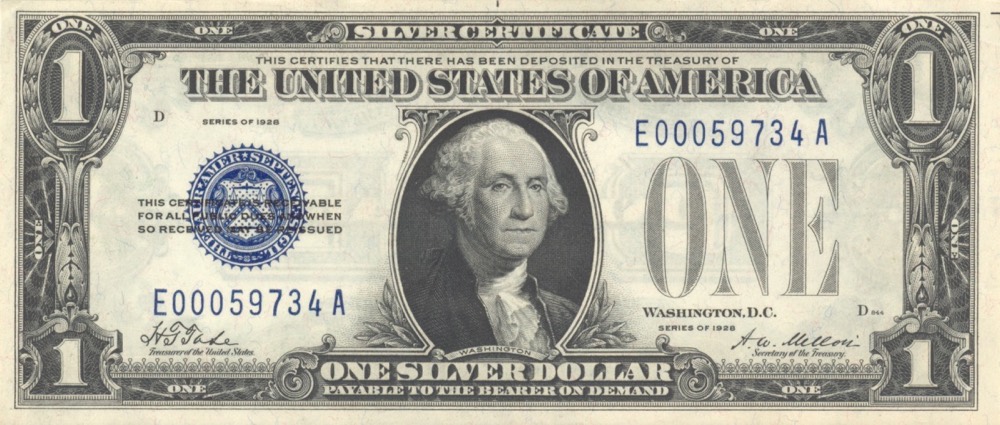
Series 1928. Nicknamed the "Funnyback": the Treasury seal on the front has spiked rays, and the text below the Washington portrait reads ONE SILVER DOLLAR; the back is printed with an unusually large ONE in lighter green ink, a design element newly added compared with the previous (1923) issue.
Signatures by series letter
- Series 1928 — Tate (Treasurer) and Mellon (Secretary), blue seal
- Series 1928A — Woods (Treasurer) and Mellon (Secretary), blue seal
- Series 1928B — Woods (Treasurer) and Mills (Secretary), blue seal
- Series 1928C — Woods (Treasurer) and Woodin (Secretary), blue seal
- Series 1928D — Julian (Treasurer) and Woodin (Secretary), blue seal
- Series 1928E — Julian (Treasurer) and Morgenthau (Secretary), blue seal
The wording on the face
This certifies that there has (or have) been deposited in the Treasury of the United States of America X silver dollar(s) payable to the bearer on demand (some versions read "X dollars in silver coin payable to the bearer on demand")
How to confirm the series
- The Treasury seal on the front is blue with spiked rays
- The text below the Washington portrait reads ONE SILVER DOLLAR (not yet changed to ONE DOLLAR)
- The back is the "Funnyback": an unusually large, lighter-green ONE in the center
- The serial numbers are blue
Easily confused with
Difference from the 1934 series: the 1934 series changed the front text to ONE DOLLAR and moved the seal to the right, overlapping the ONE, and added a blue numeral 1 on the left; but the Funnyback design on the back is the same as 1928, so the back alone cannot distinguish 1928 from 1934 — check the front text and seal position instead.
Distinguished from the 1928 series only by the signatures.
Distinguished from the other 1928 lettered varieties only by the signatures.
How much is a $1 Silver Certificate Series 1928 worth?
Greysheet (Greensheet & Friedberg CPG) retail value ranges, updated September 25, 2026, from a worn circulated note to a top-grade crisp uncirculated one:
- 1928 (Fr. 1500): $80–$8,000
- **1928 Star Replacement (Fr. 1500*):** $1,100–$35,000
- 1928 (Fr. 1600): $21–$1,200
- **1928 Star Replacement (Fr. 1600*):** $50–$1,900
- 1928A (Fr. 1601): $21–$1,000
- **1928A Star Replacement (Fr. 1601*):** $30–$3,000
- 1928B (Fr. 1602): $20–$1,400
- **1928B Star Replacement (Fr. 1602*):** $65–$4,000
- 1928C (Fr. 1603): $68–$3,000
- **1928C Star Replacement (Fr. 1603*):** $1,800–$18,000
- 1928D (Fr. 1604): $30–$2,500
- **1928D Star Replacement (Fr. 1604*):** $1,000–$100,000
- 1928E (Fr. 1605): $200–$3,000
- **1928E Star Replacement (Fr. 1605*):** $5,500–$34,000
The low end is a folded, circulated note; the high end is a gem uncirculated note, usually one certified by PMG or PCGS Banknote. Star notes (a star next to the serial number) replaced misprinted sheets and usually sell above the regular note. Condition moves the price more than anything else: a note that has been folded even once is no longer uncirculated. Fancy serial numbers can add more; check yours with the serial number checker.
How much is a 1928 silver certificate worth today?
A circulated 1928, 1928A or 1928B $1 silver certificate lists $8–$22, while the scarcer letters list higher: 1928C $20–$125, 1928D $20–$55 and 1928E $300–$700+ (US Currency Auctions, viewed September 25, 2026). Uncirculated notes list $50+ for 1928 to 1928B, $300+ for 1928D, $450+ for 1928C and $1,500+ for 1928E. Those are Fine to Extremely Fine figures; the Greysheet ranges in the chart above run from a worn low grade up to top-grade certified notes, which is why their upper ends are much higher.
Note on Fr. 1500 in the chart above
The first two lines of the Greysheet chart above, 1928 (Fr. 1500) and its star (Fr. 1500*), come from Greysheet's legal tender listing: Fr. 1500 is the Series 1928 $1 United States Note, which has a red seal, not a blue one. It is not a silver certificate. Wikipedia notes that only a small number of these red-seal $1s entered circulation when issued in 1933 and the rest were kept in Treasury vaults until 1949, when they were issued in Puerto Rico. US Currency Auctions lists it at $20–$50 circulated and $250+ uncirculated (viewed September 25, 2026). If your 1928 $1 has a blue seal, use the Fr. 1600 to Fr. 1605 lines.
What makes a 1928 bill rare
Three things: the series letter, a star, and condition. Among blue-seal $1s, 1928C, 1928D and 1928E are the scarce letters. 1928C and 1928D carry the signature of William H. Woodin, who was Secretary of the Treasury only from March 1933 to December 31, 1933 (Wikipedia), and 1928E carries the Julian and Morgenthau pair. Stars on these letters are the most valuable: Greysheet (September 25, 2026) ranges the 1928C star at $1,800–$18,000, the 1928D star at $1,000–$100,000 and the 1928E star at $5,500–$34,000. On the plain 1928, 1928A and 1928B, a note that has never been folded is the main thing that lifts the price.
How to find the serial number and value your 1928 note
The serial number is printed in blue on the front: a letter, eight digits and a letter; on these older notes a replacement star usually comes before the number, as in *75681423A (US Currency Auctions). Then:
- Read the series letter next to the year, or match the signatures in the list above.
- Check the seal colour: blue means silver certificate, red means the Fr. 1500 United States Note.
- Look for folds, soiling and edge wear; any fold means it is not uncirculated.
- Compare with the price lines above. For a 1928C, 1928D, 1928E or any star, grading by PMG or PCGS Banknote is worth it before selling.
FAQ
How do I know which Series 1928 letter my bill is?
The series year and letter are printed on the face near the portrait. If the letter is worn, match the two signatures against the list above; each letter has its own pair.
Is a $1 Silver Certificate Series 1928 still legal tender?
Yes at face value, but it can no longer be exchanged for silver; that redemption ended in 1968.
Does a star make my $1 Series 1928 note rare?
Only if its print run was small. The star alone does not.
How much is a 1928 silver certificate worth today?
$8–$22 circulated for 1928 to 1928B, $20–$125 for 1928C, $20–$55 for 1928D and $300–$700+ for 1928E (US Currency Auctions, viewed September 25, 2026).
What makes a 1928 bill rare?
The series letter (1928C, 1928D, 1928E), a star before the serial number, and uncirculated condition.
How do you determine the value of a silver certificate?
Identify the series and letter, check for a star and fancy serial, grade the condition honestly, then compare with a dated guide such as Greysheet or US Currency Auctions.
How can I find the serial number of a 1928 silver certificate?
It is printed in blue on the front, a letter, eight digits and a letter. A star before the number marks a replacement note.
More in Silver Certificate Value by Series: $1, $5 and $10 Price Chart
Related
See what your notes are really worth.
Start with a single scan.
Have one? Scan it to see what it's worth.
Sources
- greysheet.comwww.greysheet.com/prices/sp/
- Wikipediaen.wikipedia.org/wiki/United_States_one-dollar_bill
- uscurrencyauctions.comwww.uscurrencyauctions.com/$1-us-currency-value-price-guide.html
- uscurrencyauctions.comwww.uscurrencyauctions.com/us-currency-star-notes-value-price-guide.html
- Wikipediaen.wikipedia.org/wiki/William_H._Woodin
Compiled by the NoteLens editorial team
Every fact on this page is taken from the sources listed above; numbers and prices are copied from the source, and prices name the guide or auction and its date. Research and drafting were assisted by AI, and each claim was then checked against the cited sources. Checked 2026-09-25. We do not buy, sell or grade items; the app identifies what you photograph and points you to these references.